Pre-seed round 2026 · Brisbane, Australia

Sovereign infrastructure intelligence for the AI data-centre era.

One platform for power, cooling, security and capacity — sensing, visualising and recommending across the whole facility, with every byte of telemetry kept on-premises.

Zero data egress
Cloud-managed
Operator approved
Rackview overview dashboard on a laptop — live IT load, PUE, AI insights and rack thermal map

Why · The problem

Two bad options. One full floor.

Cloud or on-premise. Two options, both compromised — and every data centre still has to pick one.

No safe choice

Go cloud and your telemetry leaves the building; stay on-prem and you inherit the patching, scaling and uptime burden.

Ten tools, one floor

Power, cooling, fire, security and capacity each live in their own pane, reconciled by hand — just as something's gone wrong.

Built before AI

A pre-AI baseline retrofitted for the 40 kW+ racks, liquid cooling and dynamic workloads it was never designed to model.

Pricing punishes growth

Volume-based billing means the denser and busier your facility grows, the more your monitoring quietly costs.

Why · The pressure

Three forces. One direction.

Three forces are converging on operators at once. Each makes the old trade-offs more expensive — and each plays directly to the platform we're building.

01

Sovereignty is non-negotiable

Regulators, banks and government now demand data stay onshore — without giving up a modern, managed experience.

02

AI rewrites the envelope

Training clusters push past 40 kW, forcing liquid cooling and dynamic loads static planning can't model.

03

Fragmentation is a cost centre

Running a different stack per jurisdiction and domain adds up to a third to TCO and stalls response.

The platform

One platform for the whole facility.

Rackview unifies every physical-infrastructure domain into one live system of record — one data model, one interface, one source of truth — then layers intelligence over all of it.

Power
Cooling
Fire
Leak
Security
Network
Racks
Containment

System proposes. Operator approves.

Every AI-driven recommendation requires explicit human confirmation. Nothing changes on the floor without an operator — by design.

Features · Five pillars

01 / 05

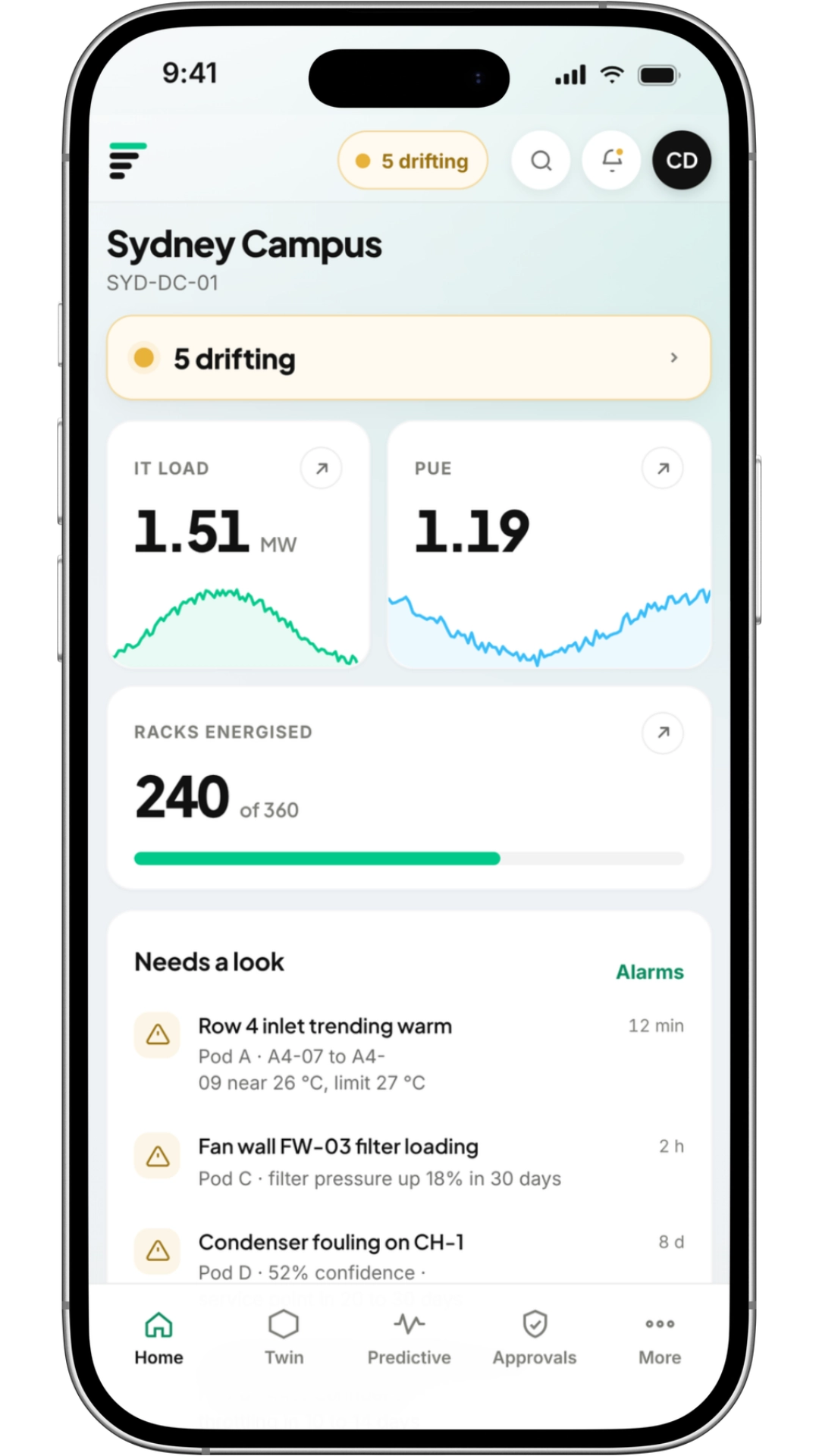
Unified overview dashboard.

One control-room view, built around your facility — live KPIs, an AI load forecast, a rack thermal map and an insights feed, all from a single source of truth. On the desktop, on the floor, or on your phone.

Rackview mobile overview — IT load, PUE, load forecast and rack thermal map
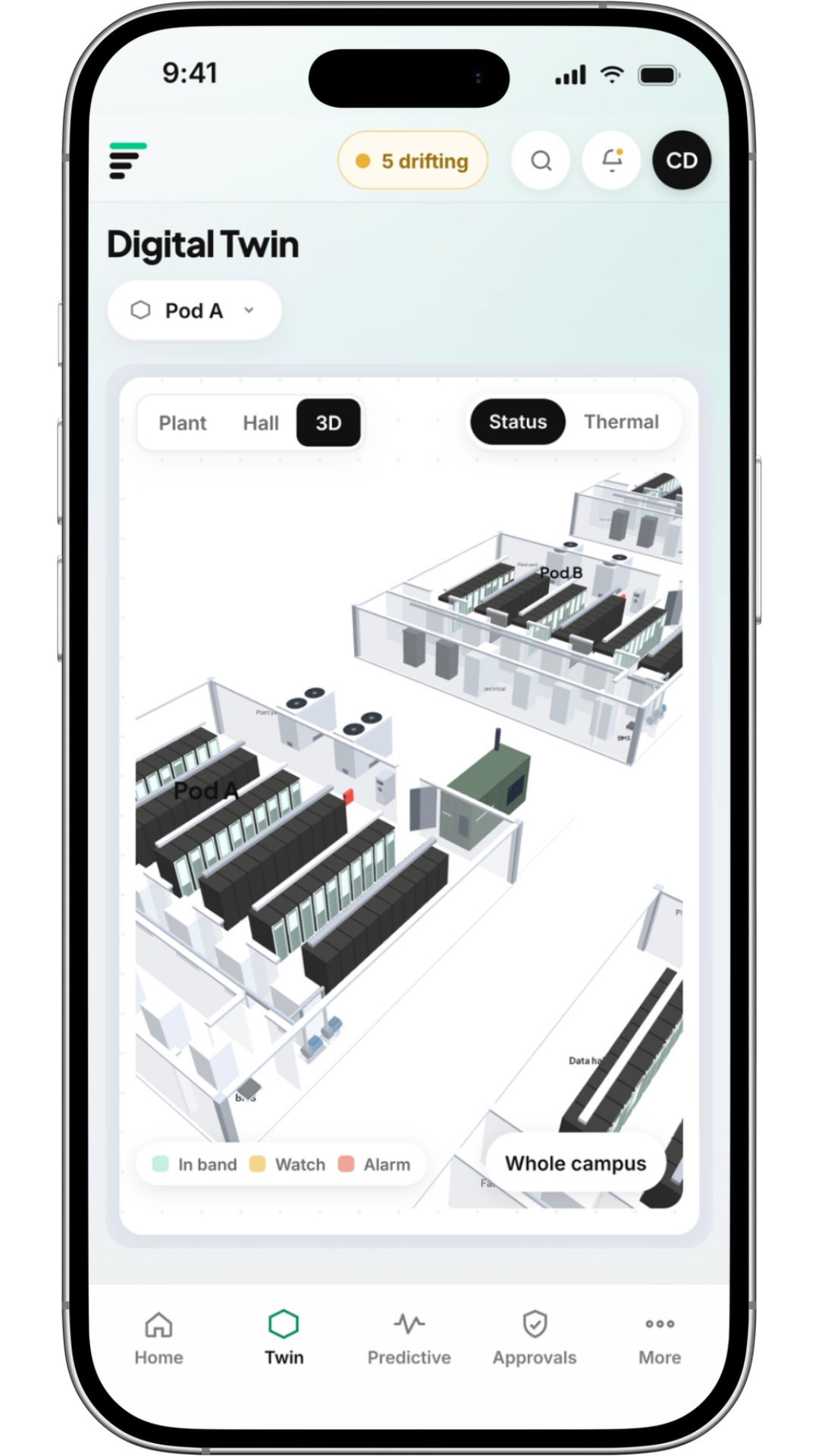
Rackview digital twin — graphical system builder with live telemetry on Pump P-04

02 / 05

A living digital twin.

Not a static floor plan — a graphical system builder that mirrors your real plant. Drag components onto the canvas, map sensors to assets over Modbus and BACnet, then flip from Edit to Live and watch it run on real telemetry.

03 / 05

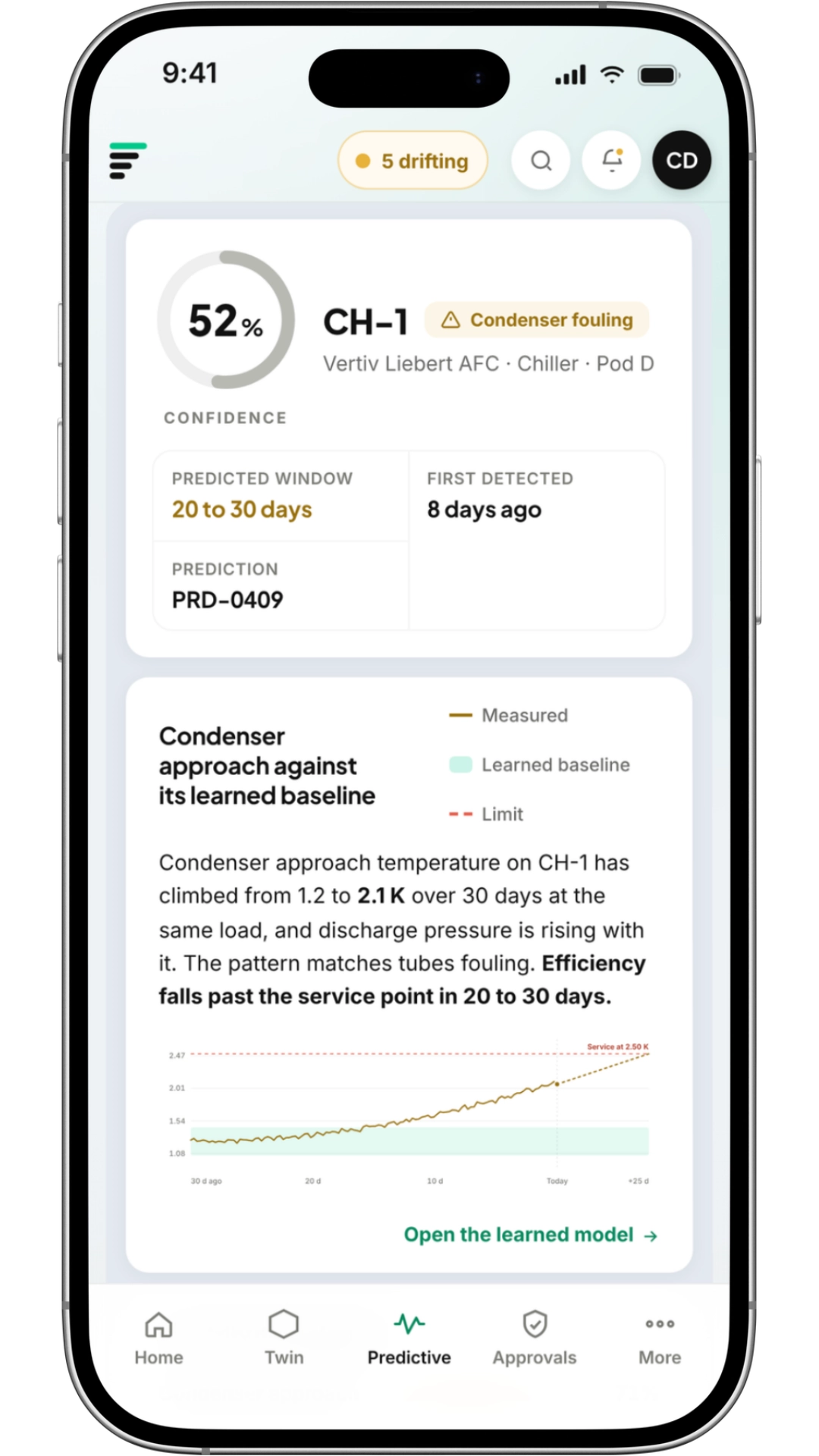
Predictive maintenance that explains itself.

Rackview learns a baseline for each asset, compares it against the fleet to catch early failure signatures, and surfaces recommendations with a confidence score and a plain-English reason. Recorded outcomes feed back in, so predictions get sharper with every deployment.

PumpsChillersCooling towersUPSGeneratorsSwitchgearPDUs
Rackview predictive maintenance — Pump P-04 vibration vs baseline with signal contributions
92/100Recommended placement
Row C · Rack R-14
Thermal headroom+4.2 °C
Power utilisation78 → 84%
Network2 ports free

04 / 05

Rack placement recommendations.

Weighs RU, power, cooling and network capacity together and returns scored options — each with an impact report, so a new rack lands where the facility can actually carry it.

05 / 05

Efficiency & optimisation.

Models setpoint, fan-speed and duty/standby scenarios and quantifies each in dollars saved alongside PUE and WUE impact — every one scored, costed and approvable.

Raise CRAC-02 setpoint +1.5°CSCENARIO
Estimated saving~$1,840 /mo
PUE1.32 → 1.28
WUE−3%
Thermal riskNone

FOUNDATION

Device templates

Map a make and model once — protocol, OIDs and registers into canonical fields — and reuse it everywhere. New gear is a lookup, not a project.

FOUNDATION

Canonical telemetry schema

Every reading, any vendor or protocol, normalised into one record. Dashboards, twin and models all speak one language.

FOUNDATION

Multi-protocol ingest

MQTT, SNMP, Modbus and BACnet first-class at the edge — meeting the building's systems where they already are.

FOUNDATION

Integrate, don't reinvent

Smoke from certified fire systems; energy from existing smart PDUs. Intelligence on trusted sources — never a replacement for safety-critical hardware.

Intelligence · Approach

Machine learning, with a human in the loop.

A disciplined ML layer for critical infrastructure — where being wrong has physical consequences, and trust is earned through transparency and control. Every model output is a recommendation, never an autonomous action: actuation is operator-confirmed, per-action, and off by default.

Explainable by default

Recommendations ship with the evidence — deviation, peers, a plain reason — so operators can judge, not just obey.

Confidence-scored

Each insight carries a calibrated confidence; a high-certainty alert and an early hunch are never the same.

Sovereign by design

Telemetry lives at the edge, so models learn and run on-premises — intelligence without shipping data off-site.

MODELS

Baseline & anomaly

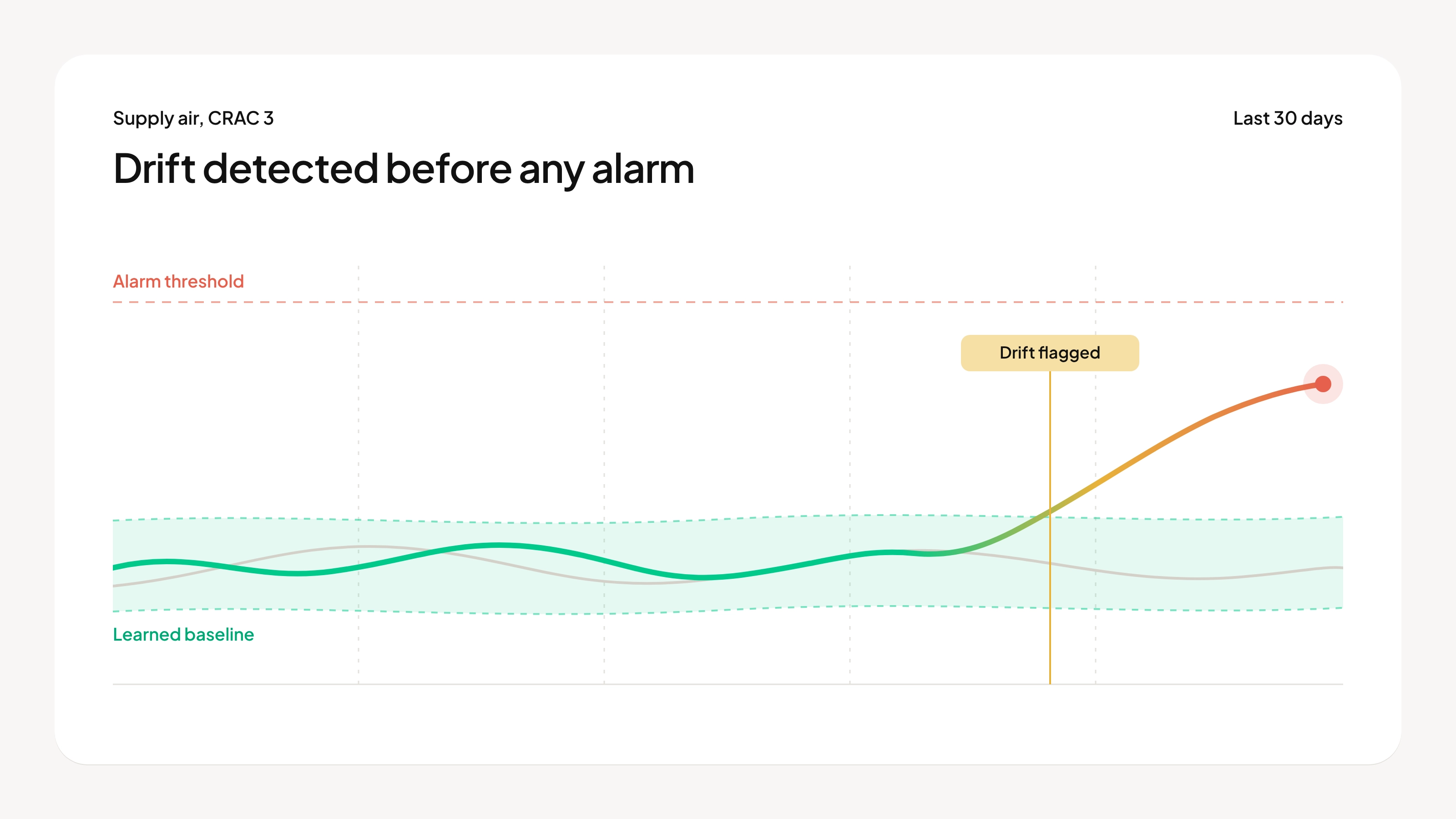
Per-asset models learn the normal envelope and flag subtle drift before a fixed threshold would trip.

MODELS

Fleet & transfer

An asset is judged against its peers — caught misbehaving even with little history, with lessons transferring between sites.

MODELS

Load forecasting

Forecasts project facility load and headroom forward — an early-warning instrument, not a rear-view mirror.

MODELS

Scenario optimisation

Simulate setpoint, fan and duty/standby changes; quantify the dollar and PUE/WUE impact; rank the options.

MODELS

Placement scoring

Weighs RU, power, cooling and network capacity together to rank where a new rack should go.

MODELS

Outcome learning

Recorded failure and maintenance events feed back, so accuracy and calibration improve every deployment.

The differentiator

Sovereign without the on-prem ops tax.

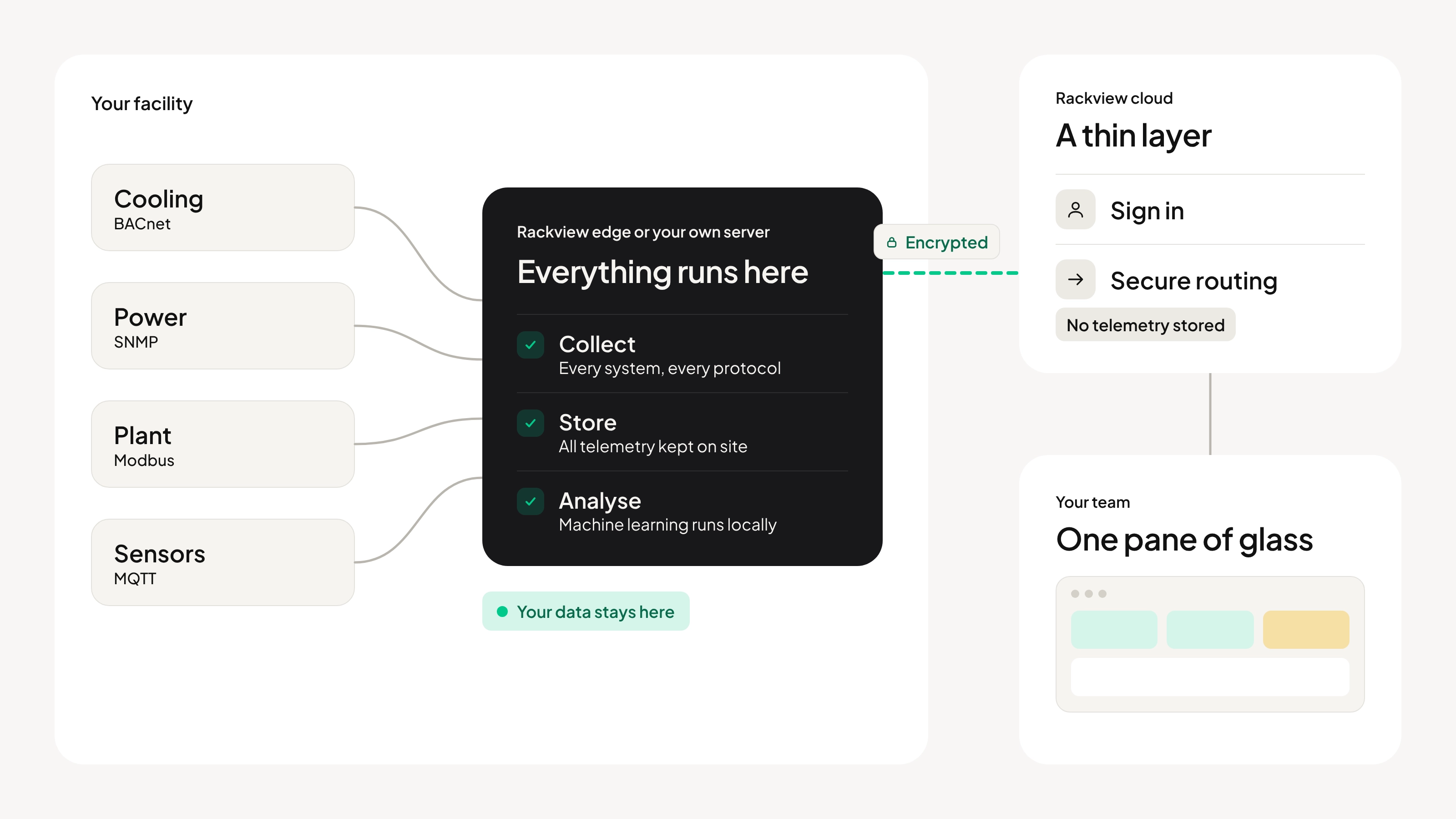
A hybrid control plane: telemetry never leaves the edge, while the cloud delivers the managed convenience operators expect from modern software.

01

On-prem edge

Active-passive appliance pair. All telemetry, history and control stay inside your walls.

02

Encrypted tunnel

Pure proxy. The cloud relay sees only ciphertext — it cannot inspect, cache or transform a value.

03

Cloud control plane

Auth, UI and routing only. No third party sits in the data path.

Zero data egress

Sovereign by architecture — onshore and operator-controlled, not by policy promise.

Managed convenience

No on-prem ops burden. Identity, UI and updates handled in the cloud.

Margin that scales

Cloud COGS decoupled from telemetry volume — costs grow with users, not data.

Why now

Architected for AI — not retrofitted.

Designed from day one for the conditions that break a pre-AI baseline: GPU clusters, high-density racks, liquid cooling and dynamic workloads — in a growing market tilting to sovereignty.

GPU-dense by default

Built for AI-training clusters where rack densities now approach and exceed 40 kW.

Liquid-cooling native

Models the chilled-water and direct-liquid loops modern DCs depend on — not just CRAC airflow.

Dynamic-load aware

Designed for workloads that spike and shift in minutes, where static capacity planning fails.

Telemetry at the edge

High-frequency data lives on-site, so adding density never inflates cloud cost.

~22%DCIM market CAGR to early 2030s
APACFastest-growing DCIM region
TCO penalty for per-region stacks
40kW+Densities the platform is built for

The landscape

Everyone picks a corner. We took the centre.

Incumbents force the choice between cloud convenience and sovereign control. Rackview occupies the open top-right corner — both at once.

SOVEREIGN / ON-PREM → CLOUD-MANAGED CONVENIENCE → Schneider Aravolta Nlyte Device42 EkkoSense Sunbird Hyperview Rackview

Pure-proxy, single deployment

Sovereign and cloud-managed at once — not two modes.

Sovereign in any jurisdiction

Architected so data stays in-country anywhere — proven first in APAC, applicable worldwide.

Margin decoupled from telemetry

Cloud cost grows with users, not data.

AI-era architecture

Built for GPU density, liquid cooling and dynamic loads — not a pre-AI tool retrofitted.

Hardware · Roadmap

The universal sensor — coming later.

The platform ships first on existing protocols and your installed sensors. Owning the sensing layer is a deliberate next phase that deepens the moat — never a v1 dependency.

UNIVERSAL SENSOR NODE · BATTERY / DC · SUB-GHZ MESH + BLE

One part number, any measurement

A single node whose role is set in firmware — temperature, humidity, 4–20 mA, 0–10 V, dry-contact, door or relay-out — so one SKU covers every sensing job on the floor instead of a drawer of specialised devices.

GATEWAY · POE · LINUX · MESH-TO-IP BRIDGE

Clean telemetry, straight to the edge

A PoE bridge that links the sub-GHz sensor mesh to IP and hands clean, canonical telemetry straight to the on-prem edge appliance.

Pre-seed round 2026

Sovereign by architecture.
Intelligent by design.

One platform for the whole facility — with the data kept where it belongs. The architecture is locked, the cloud foundations are live, and the round is now open to investors.

Enquire about the round →

Round terms, financial model and the full investment memorandum are shared on enquiry. Confidential — not an offer of securities.