Why your data centre data should never leave your site
If you run your own data centre, you've probably faced the same choice when looking at management software.
On one side are legacy on premises tools. They keep your data in house, but they're slow to deploy, expensive to maintain and years behind on features. On the other side are modern cloud platforms. They look great and update constantly, but they ask you to stream your facility's telemetry to servers you don't control.
For a lot of operators, neither option is acceptable.
Your telemetry is more sensitive than it looks
It's easy to think of power and temperature readings as harmless. But put them together and they become a detailed picture of your facility.
They show where your critical equipment sits and how it's connected. They reveal load patterns, capacity limits and redundancy gaps. They show when systems are under stress and which ones would hurt most if they failed.
For a university research cluster, a defence supplier or a mining operation, that's not information you want sitting in a third party's cloud, in a jurisdiction you didn't choose, alongside thousands of other customers' data.
The rules are catching up
This isn't only a matter of preference. Australia's critical infrastructure laws now cover data storage and processing, and many organisations face their own obligations around where operational data lives and who can reach it. Defence supply chains, government contracts and research agreements often carry requirements that rule cloud first tools out entirely.
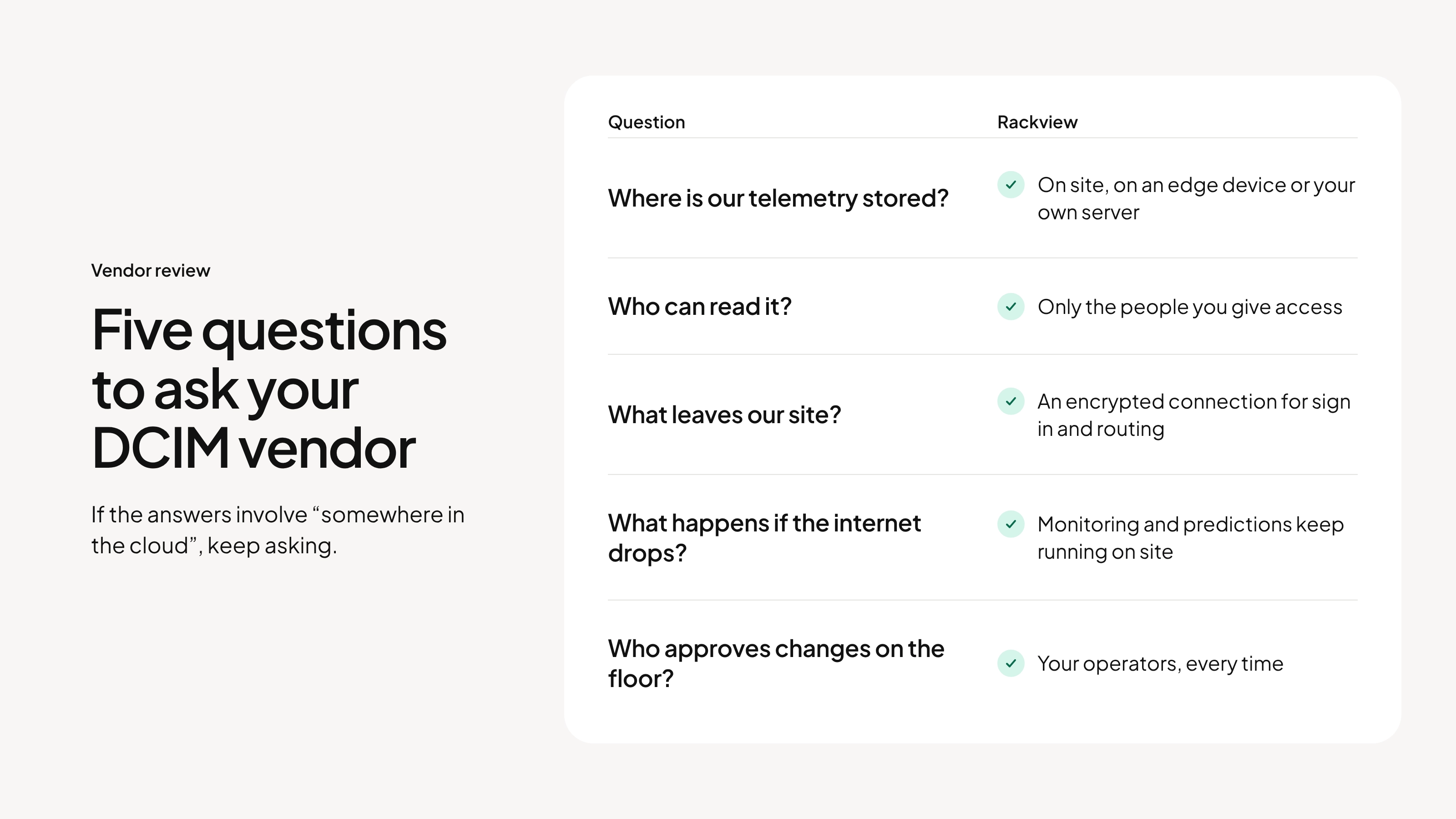
Even where the rules don't demand it, security teams increasingly ask the question during vendor reviews: where does this data go, and who else can see it?
"Somewhere in the cloud" is getting harder to defend
Hybrid control: the third option
There's a way to get modern software without sending your data away. We call it hybrid control.
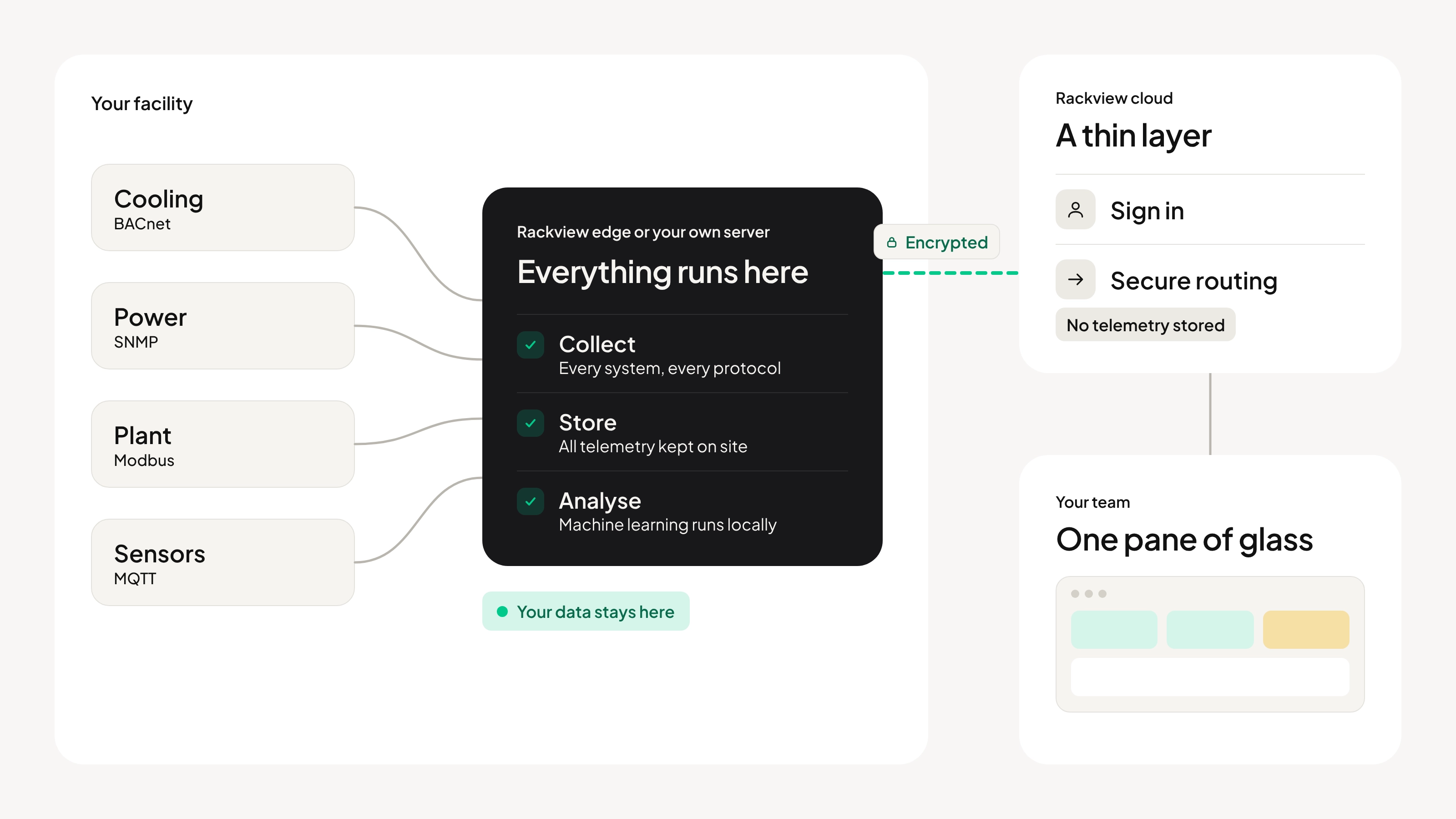
In a hybrid model, everything that touches your telemetry runs inside your facility. Data is collected, stored and analysed on site, either on a dedicated edge device or on a server you already own. The machine learning that spots failures runs there too.
The cloud plays a much smaller role. It handles sign in and securely routes your connection to your site, so you can reach your dashboard without exposing your network. The connection is encrypted end to end, and the cloud never stores your telemetry or reads it.
You get a modern interface, continuous updates and secure access. Your data stays exactly where it started.
It also keeps working when the internet doesn't
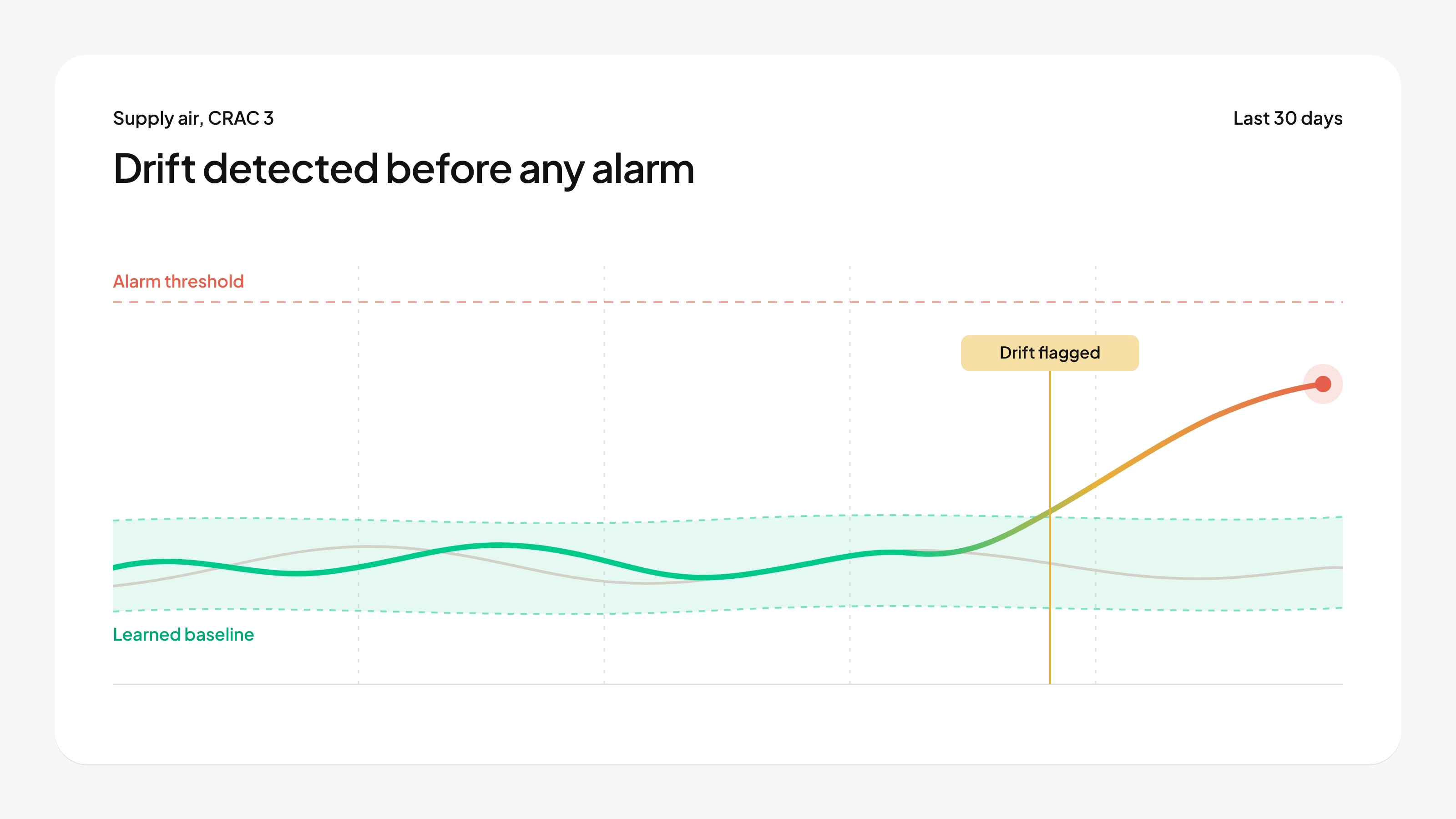
There's a practical benefit too. When monitoring and analysis run on site, they don't stop if your internet link goes down. Alarms still fire. Data is still recorded. Predictions keep running.
For a facility whose whole job is staying up, depending on an outside connection to know what's happening inside your own walls has always been an odd trade.
Control over changes, not just data
Sovereignty isn't only about where data lives. It's also about who decides what happens on your floor.
As management tools get smarter, they increasingly suggest actions: adjust a setpoint, rebalance a load, schedule a service. Those suggestions are valuable. But in a critical facility, nothing should change without a person signing off.
The right model is simple: the system proposes, the operator approves. Your team stays in control of every change, with a clear record of who approved what.
You shouldn't have to choose
For years, operators have had to pick between modern tools and control over their own data. That trade off was never necessary. It was just how the software was built.
Keep your data on site. Keep your team in charge of every change. And still get the predictive insight and single view that modern data centres need.
Rackview runs on a Rackview edge device or your own server, keeps every reading inside your facility, and uses the cloud only to sign you in and route an encrypted connection. Book a demo to see how it works.